
Congratulations on turning 16 (or almost 16)! You’ve officially unlocked a whole new level in the game of life—the ability to work at way more places than your 14-15-year-old self could. Welcome to the world of actual paychecks, coworkers who might become lifelong friends, and the sweet satisfaction of buying things with money you earned yourself.
But let’s be real: the idea of getting your first job can feel overwhelming. You’re probably wondering where to even start. How do you write a resume when you’ve literally never had a job? What do you say in an interview when your biggest accomplishment is beating that one impossible level in your favorite game? And how on earth are you supposed to balance work with school, sports, friends, and—oh yeah—sleep?
Don’t worry. This guide has your back. We’re going to walk through everything you need to know about landing your first job at 16-17, from creating a resume that actually looks professional to nailing your interview and managing your new work-life balance without losing your mind.
By the time you finish reading this, you’ll be ready to confidently apply for jobs, interview like a pro, and show up to your first day knowing exactly what to expect. Let’s get started.
Best First Jobs for 16-17 Year Olds
The good news? At 16-17, you have way more options than younger teens. You’re no longer limited to scooping ice cream (though that’s still a solid gig). Let’s break down the best places to apply and what you can realistically expect.
Retail Giants That Actually Want to Hire You
Big box stores are your friends. They hire tons of teenagers, have structured training programs, and often offer benefits even for part-time workers. Plus, they’re always hiring because, let’s face it, turnover is real.
Target
- Positions available: Sales floor team member, cashier, cart attendant, stock team
- Starting pay: $15-17/hour (varies by location, but Target pays well)
- Why it’s great: Employee discount (15% plus extra on Target brands), flexible scheduling, opportunity to move up, they actually train you properly
- The reality check: Can be busy and stressful during holidays, you’ll be on your feet a lot, weekend shifts are basically required
- Pro tip: Target loves to promote from within. Start as a cart attendant if you have to—you can work your way up to electronics or Starbucks pretty quickly.
Walmart
- Positions available: Cashier, stocker, online order fulfillment, customer service, garden center
- Starting pay: $14-16/hour
- Why it’s great: Tons of locations so probably one near you, flexible hours, associate discount, room for advancement
- The reality check: It’s Walmart. You’ll deal with interesting customers. Your people-watching skills will level up dramatically.
- Pro tip: The online order fulfillment position (picking and packing orders) is one of the better jobs because you’re not stuck at a register all day.
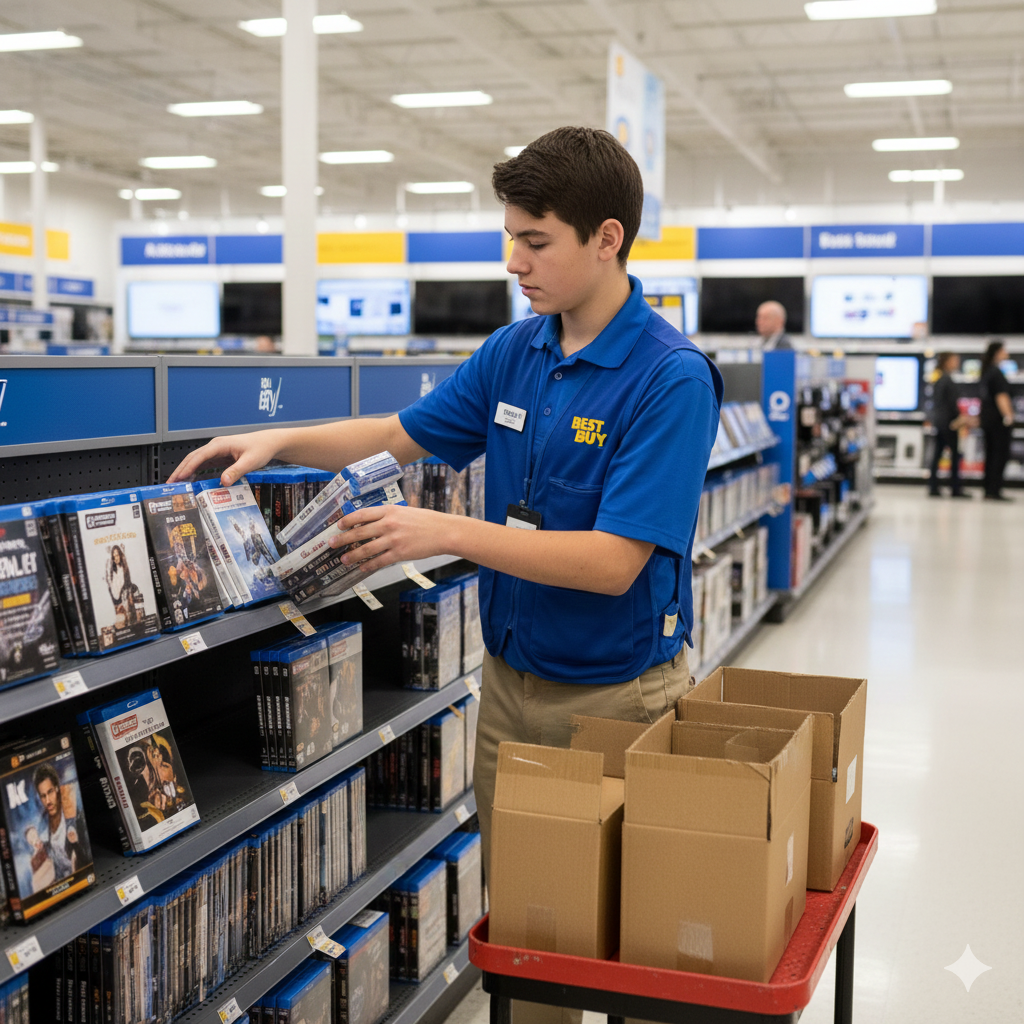
Best Buy
- Positions available: Sales associate, inventory specialist, customer service, warehouse
- Starting pay: $15-16/hour
- Why it’s great: If you’re into tech, this is perfect. You’ll learn about products, get an employee discount on electronics (dangerous for your wallet), and it looks impressive on future resumes
- The reality check: You need to actually know about tech or be willing to learn fast. Black Friday will test your sanity.
- Pro tip: They love hiring teens who are genuinely interested in technology. Mention any tech clubs, building PCs, or even just being the family tech support person.
Old Navy, Gap, American Eagle (and other clothing stores)
- Positions available: Sales associate, stock associate, cashier
- Starting pay: $12-15/hour
- Why it’s great: Generous employee discounts (usually 30-50% off), fun atmosphere, lots of other teens working there, you’ll develop serious folding skills
- The reality check: Folding. So. Much. Folding. And people will unfold everything you just spent 20 minutes organizing.
- Pro tip: If you have any interest in fashion or retail management, these places are great learning experiences. Plus, the discount basically pays for your work wardrobe.
Fast Food and Quick Service Restaurants
Don’t knock it until you try it. Fast food teaches you speed, multi-tasking, and how to stay calm under pressure. Plus, most places are super flexible with high school schedules.
McDonald’s
Want the full playbook — not just this one article?
Fast Track to Hired is the $10 no-BS field manual that walks you from "why is nobody calling me back?" to a signed offer in 1–3 weeks. Applications, follow-ups, personality tests, interviews — all covered. Plus 5 free bonuses including 40+ word-for-word interview scripts.
Get The Playbook — $10 → Instant PDF · 5 bonuses included · 30-day money-back guarantee- Positions available: Crew member (cashier, food prep, drive-thru)
- Starting pay: $12-14/hour
- Why it’s great: They’ll hire almost anyone willing to work hard, super flexible scheduling, free or discounted meals, they train you on everything
- The reality check: It’s fast food. It’s hot, it’s busy, some customers are rude, and you’ll smell like fries after every shift (which honestly isn’t the worst thing)
- Fun fact: A surprising number of successful people started at McDonald’s. It’s not glamorous, but it teaches work ethic like nothing else.
Wendy’s
- Positions available: Crew member, cashier
- Starting pay: $12-14/hour
- Why it’s great: Similar to McDonald’s but usually slightly less chaotic, free meals during shifts
- The reality check: Weekend and evening shifts are the busiest. Hope you like Frostys because you’ll be around them constantly.
Taco Bell
- Positions available: Team member, cashier, food prep
- Starting pay: $12-14/hour
- Why it’s great: Usually more laid-back atmosphere than burger places, free food, often understaffed which means more hours if you want them
- The reality check: Late-night shifts can attract… interesting customers.
Panera Bread
- Positions available: Associate, cashier, line cook
- Starting pay: $13-15/hour
- Why it’s great: Free meals, cleaner environment than typical fast food, slightly higher pay, looks better on resume than burger joints (don’t @ me, but it’s true)
- The reality check: Memorizing all those sandwich combinations is harder than it looks. Also, you’ll never want to eat bread bowls again.
Chipotle
- Positions available: Crew member
- Starting pay: $14-16/hour
- Why it’s great: Free food (chipotle every day!), tuition assistance program (up to $5,250/year for education), actually teaches you real cooking skills, fast-paced environment
- The reality check: The assembly line during lunch rush is intense. You’ll develop arm muscles from scooping rice and beans. And yes, people will ask for “a little more cheese” seventeen times.
Specialty Food and Beverage
These jobs are usually a step up from traditional fast food and often have better work environments.
Starbucks
- Positions available: Barista
- Starting pay: $13-16/hour
- Why it’s great: Amazing benefits even for part-time (health insurance, free college through Arizona State University, free drinks during shifts, weekly free pound of coffee), tips, you’ll master a valuable skill
- The reality check: The drink combinations are overwhelming at first. You’ll get people ordering TikTok drinks that aren’t even on the menu. Peak morning rush is chaos.
- Pro tip: If you can handle the initial learning curve, Starbucks is one of the best first jobs out there. The benefits are legitimately incredible for a part-time high school job.
Dunkin’
- Positions available: Crew member, barista
- Starting pay: $12-14/hour
- Why it’s great: Tips, free drinks and donuts, usually great team atmosphere, early morning shifts available (if you’re a morning person)
- The reality check: Early morning shifts mean EARLY (like 5 AM). But you’re done by early afternoon, which is nice.
Smoothie King, Jamba Juice, etc.
- Positions available: Team member
- Starting pay: $11-13/hour
- Why it’s great: Usually chill atmosphere, free smoothies, easier than coffee shops, generally positive vibes
- The reality check: It’s loud (blenders), sticky (smoothie spills), and people take their açai bowls very seriously.
Grocery Stores
Grocery stores are underrated first jobs. They’re everywhere, always hiring, and teach you tons of transferable skills.
Kroger (and family stores: Fred Meyer, Ralph’s, etc.)
- Positions available: Courtesy clerk (bagger), cashier, stocker
- Starting pay: $12-14/hour
- Why it’s great: Union jobs often mean better pay and protection, benefits available, lots of different departments to potentially transfer to
- The reality check: Bagging groceries sounds easy until you realize people have opinions about how their groceries should be bagged. Strong opinions.
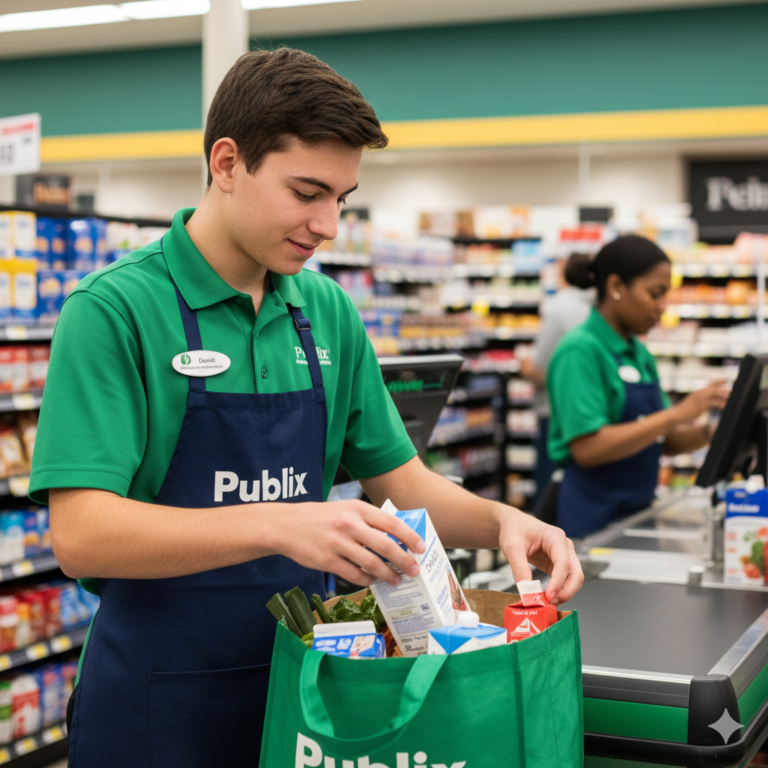
Publix
- Positions available: Front service clerk (bagger), cashier, deli clerk, stock clerk
- Starting pay: $12-14/hour
- Why it’s great: Known for treating employees well, profit-sharing plan, free sub on your birthday, strong company culture, promote from within
- The reality check: They have high standards for customer service (in a good way, but it means you need to be “on” your whole shift)
- Fun fact: Publix is employee-owned, which means after a year you start earning stock. That’s actually pretty cool.
Safeway/Albertsons
- Positions available: Courtesy clerk, cashier, stocker
- Starting pay: $13-15/hour
- Why it’s great: Often union jobs with better benefits, flexible scheduling, various departments
- The reality check: Pretty standard grocery store experience—not bad, not amazing, just solid.
Whole Foods
- Positions available: Team member (various departments)
- Starting pay: $15-17/hour
- Why it’s great: Higher pay, awesome benefits (Amazon Prime membership included!), 20% employee discount (huge when you’re buying groceries), great work culture
- The reality check: Customers at Whole Foods… are particular. You’ll field questions about whether the organic kale is locally sourced way more often than you’d think.
Entertainment Venues
If you want a fun job where work doesn’t always feel like work, entertainment venues are where it’s at.
AMC Theatres, Regal Cinemas
- Positions available: Usher, box office, concessions
- Starting pay: $11-13/hour
- Why it’s great: Free movies (sometimes unlimited), you can watch movies during slow times, concessions snacks, fun coworkers, relatively chill
- The reality check: Cleaning theaters after the Saturday night showing is… an experience. People are gross. You’ll find things. Things you wish you hadn’t found.
- Pro tip: Work box office if you can—it’s air-conditioned and you don’t have to deal with popcorn butter.
Six Flags, Cedar Point, Local Amusement Parks
- Positions available: Ride operator, games attendant, food service, guest services
- Starting pay: $12-15/hour
- Why it’s great: Free park admission, bring friends for free sometimes, fun summer job, meet tons of people your age, usually includes cool perks
- The reality check: Summer heat, standing all day, dealing with kids having meltdowns, working every weekend and holiday in summer
- Worth it though? If you like roller coasters and don’t mind the heat, absolutely.
Warehouse and Logistics
These jobs pay surprisingly well for first jobs, though they’re more physically demanding.
Amazon
- Positions available: Warehouse associate, sortation center associate
- Starting pay: $18-19/hour (Amazon pays well!)
- Why it’s great: High pay, flexible shifts, tuition assistance ($5,250/year), can work just weekends, sign-on bonuses sometimes, opportunity for advancement
- The reality check: It’s physical work. You’ll hit your step goal every single day. The warehouse is huge. You’ll get buff though, so there’s that.
- Pro tip: If you can handle the physical aspect, Amazon is one of the highest-paying options for teen workers.
UPS
- Positions available: Package handler
- Starting pay: $15-21/hour (part-time, but great benefits)
- Why it’s great: Excellent benefits (even part-time gets health insurance), tuition assistance, room for advancement, workout included (you’ll get strong)
- The reality check: Early morning shifts (like 4 AM early) or late night, physically demanding, busy during holidays (you’ll basically live there November-December)
- Pro tip: If you’re thinking about trade school or college, UPS will actually help pay for it. This is huge.
FedEx
- Positions available: Package handler, warehouse worker
- Starting pay: $15-17/hour
- Why it’s great: Flexible shifts, tuition assistance, room to grow, good benefits
- The reality check: Similar to UPS—physical work, odd hours, peak season is intense
Other Solid Options
Lifeguard
- Requirements: Lifeguard certification (Red Cross course), usually must be 15-16 minimum, current CPR/First Aid
- Starting pay: $12-16/hour
- Why it’s great: Outdoor job, looks good on resumes (shows responsibility), makes you feel like a superhero, you get tan (or sunburned, use sunscreen!)
- The reality check: You need to maintain certification, early morning shifts, constant vigilance (you can’t just scroll your phone), dealing with pool politics
- Pro tip: Community pools and HOA pools are always looking for lifeguards. Get certified in spring for summer work.
Restaurant Server/Host
- Positions available: Host, busser, food runner (server usually requires 18+)
- Starting pay: $11-13/hour plus tips for some positions
- Why it’s great: Tips can be great, you’ll develop serious people skills, fast-paced, learn to multi-task like a boss
- The reality check: People are demanding when they’re hungry. Weekend and evening shifts required. Your feet will hurt.
Local Small Businesses Don’t overlook small businesses in your area:
- Coffee shops
- Boutiques
- Pet stores
- Bookstores
- Sporting goods stores
- Frozen yogurt shops
- Local restaurants
Why they’re great: More personal, flexible, owner might take you under their wing, can be less corporate/rigid The reality check: May pay less, fewer benefits, less structured training, hours might be irregular
Creating Your Resume With No Experience
Okay, real talk: writing your first resume feels impossible. You’re staring at a blank document thinking, “I’m supposed to fill a whole page when I’ve literally never had a job?”
Here’s the secret: you have more to put on a resume than you think. You might not have work experience, but you have school experience, activities, volunteer work, and skills. Employers hiring 16-17-year-olds know you don’t have a work history—they’re looking for signs that you’re responsible, teachable, and won’t ghost them after two weeks.
Resume Format for Teens
Keep it simple and professional. No crazy fonts, colors, or graphics unless you’re applying for a creative position (and even then, be careful). You want to look professional, not like you designed it in Canva at 2 AM.
The Basics:
- One page (seriously, no one wants to read a two-page resume from a 16-year-old)
- Standard fonts: Arial, Calibri, or Times New Roman
- 11-12 point font for body text
- Clear section headings
- Plenty of white space (don’t cram everything together)
- Save as PDF when sending (unless specifically asked for a different format)
Essential Resume Sections
1. Header (Your Contact Info)
Put this at the top, centered or left-aligned:
ALEX JOHNSON
(555) 123-4567 | alex.johnson@email.com
123 Main Street, Springfield, IL 62701
LinkedIn: linkedin.com/in/alexjohnson (optional but impressive)
Email address reality check: If your email is something like “partygirl2007@hotmail.com” or “xx420blazeitxx@yahoo.com,” stop right now and create a professional email. Use some combination of your name. Future you will thank current you.
Good emails:
Bad emails:
2. Objective Statement
Since you don’t have experience, an objective statement tells employers what you’re looking for and what you offer. Keep it to 2-3 sentences max. Make it specific to each job (yes, this means customizing it—I know, I know, but it makes a difference).
Generic (meh): “Responsible student seeking part-time position to gain work experience and earn money.”
Better: “Motivated high school junior seeking part-time retail position at Target where I can apply my customer service skills and attention to detail while learning about inventory management and merchandising.”
Even better (for specific job): “Enthusiastic 16-year-old with strong communication skills and genuine passion for coffee culture seeking barista position at Starbucks. Eager to learn craft coffee techniques while providing exceptional customer experiences and contributing to a positive team environment.”
See the difference? The second and third versions show you actually thought about the specific job and company. They’re personalized, show enthusiasm, and highlight relevant skills.
Templates you can customize:
For retail: “Detail-oriented high school student seeking part-time sales associate position at [Company]. Brings positive attitude, strong work ethic, and commitment to excellent customer service. Quick learner ready to contribute to team success while developing professional retail skills.”
For food service: “Energetic and reliable student seeking crew member position at [Restaurant]. Excited to work in fast-paced environment, develop teamwork skills, and deliver positive customer experiences. Available for evenings and weekends with flexible scheduling.”
For any position: “Responsible [grade] at [School] seeking first employment opportunity where I can apply my [relevant skill 1] and [relevant skill 2] while learning [something about the industry]. Committed to punctuality, following direction, and exceeding expectations.”
3. Education
This section is actually important for you since you’re still in school. Here’s what to include:
SPRINGFIELD HIGH SCHOOL, Springfield, IL
Junior (11th Grade) | Expected Graduation: May 2026
GPA: 3.7/4.0 (only include if 3.5 or higher)
Relevant Coursework: Business Management, Computer Science, Spanish III
Optional additions:
- Academic honors (Honor Roll, Principal’s List, Dean’s List)
- Perfect attendance (if you have it—shows reliability)
- Academic awards or scholarships
- AP or Honors classes (shows you challenge yourself)
Should you include your GPA?
- If it’s 3.5 or higher: Yes, definitely
- If it’s 3.0-3.4: Your call (maybe if applying somewhere that values academics)
- If it’s below 3.0: Leave it off (they’re not going to ask, and that’s okay)
4. Activities and Involvement
This is where you show you’re not just a couch potato. Include anything that demonstrates skills, leadership, teamwork, or commitment.
What to include:
Sports:
- Name of sport
- Level (JV, Varsity)
- Years participated
- Any leadership roles (Captain, Team Leader)
- Notable achievements if relevant
Example:
Varsity Soccer Team | 2022-Present
- Team Captain, 2024 season
- Demonstrated leadership by organizing extra practice sessions and mentoring new players
- Balanced 10+ hours weekly of practice/games with maintaining 3.7 GPA
- Developed time management, teamwork, and communication skills
Clubs and Organizations:
National Honor Society | 2023-Present
- Selected based on academic excellence and community service
- Complete 20+ volunteer hours per semester
- Participate in peer tutoring program

Debate Team | 2022-Present
- Compete in regional tournaments
- Developed public speaking, critical thinking, and research skills
- Placed 3rd in state qualifier, 2024

Student Government | Class Representative, 2023-2024
- Elected by peers to represent junior class
- Organize school events and fundraisers
- Advocate for student needs in monthly meetings
Other activities:
- Band, orchestra, choir
- Theater/drama club
- School newspaper or yearbook
- Academic teams (math team, Science Olympiad)
- Robotics club
- Coding club
- Art club
- Key Club
- DECA, FBLA, or other career-related organizations
Pro tip: For each activity, don’t just list it—add a bullet or two about what you actually did or learned. “Member of Art Club” is boring. “Art Club Member | Created 15+ pieces featured in student gallery; collaborated with team to organize spring art show attended by 200+ community members” is way better.
5. Volunteer Experience
This section is gold. Volunteer work shows initiative, compassion, and that you’re willing to work without getting paid (which actually makes employers trust you more). Format it just like a job.
Examples:
ANIMAL SHELTER VOLUNTEER | Paws & Claws Shelter, Springfield, IL
June 2023 - Present (or specific dates if not ongoing)
- Clean and maintain kennel facilities ensuring sanitary environment for 30+ animals
- Socialize dogs and cats to improve adoptability
- Assist with weekend adoption events, resulting in 15+ successful adoptions
- Demonstrated reliability by completing 100+ volunteer hours
YOUTH MENTOR | Springfield Community Center
September 2023 - Present
- Mentor elementary students in after-school tutoring program
- Help 5-7 children with homework and reading comprehension twice weekly
- Plan and lead educational games and activities
- Developed patience, communication skills, and ability to explain concepts clearlyFOOD BANK VOLUNTEER | Second Harvest Food Bank
Monthly, 2022-Present
- Sort and package food donations for distribution
- Assist families with food selection during distribution days
- Work efficiently as part of 10-person volunteer team
- Contributed 80+ hours serving community in needDon’t have volunteer experience yet?
It’s not too late! Here are quick volunteer opportunities:
- Help organize/run a 5K or community event
- Volunteer at your library
- Join a park cleanup day
- Help with a food drive
- Volunteer at a nursing home
- Assist with vacation Bible school or religious education
- Help coach/referee youth sports
- Tutor younger students
Even 10-15 hours of volunteer work gives you something to put on your resume.
6. Skills Section
This is where you list what you can actually do. Be honest—if you claim to be “proficient in Excel” and they ask you to create a pivot table in the interview, you’re screwed.
Technical Skills:
- Proficient in Microsoft Office Suite (Word, PowerPoint, Excel)
- Experienced with Google Workspace (Docs, Sheets, Slides, Drive)
- Basic photo editing (Canva, Adobe Photoshop)
- Social media management (Instagram, TikTok, Facebook)
- Typing speed: 60 WPM
- Basic HTML/CSS (if true)
- Video editing (iMovie, CapCut, etc.)
Soft Skills:
These are harder to prove but super valuable:
- Strong communication and interpersonal skills
- Excellent time management and organizational abilities
- Problem-solving and critical thinking
- Attention to detail
- Adaptability and quick learner
- Works well independently and as team member
- Customer service oriented
- Reliable and punctual
- Positive attitude
Language Skills:
- Bilingual: Fluent in English and Spanish (or conversational if not fluent)
- American Sign Language: Basic proficiency
Job-Specific Skills:
Tailor these to the position:
For retail:
- Cash handling experience (from club fundraisers, managing concession stand, etc.)
- Basic math skills
- Merchandising interest
For food service:
- Food handler’s permit (if you have it or willing to get it)
- Basic food safety knowledge
- Customer service experience
For child-related jobs:
- CPR certified (or willing to be)
- Babysitting experience (younger siblings count!)
- Child development coursework
7. Optional: Interests/Hobbies
One line at the bottom. This humanizes you and can be a conversation starter in interviews. Keep it clean and relatively normal.
Good examples: “Interests: Photography, reading science fiction, playing guitar, and hiking” “Hobbies: Basketball, cooking, graphic design, and volunteering with animal rescue”
Avoid:
- Anything controversial (politics, religion)
- “Hanging out with friends” (too vague/everyone does this)
- Video games (unless applying to GameStop or similar—even then, be specific)
- Anything that makes you sound lazy (“sleeping, Netflix, doing nothing”)
Resume Example for 16-17 Year Old
Here’s what it all looks like put together:
JORDAN MARTINEZ
(555) 234-5678 | jordan.martinez@email.com
456 Oak Avenue, Portland, OR 97201

OBJECTIVE
Enthusiastic high school junior seeking part-time barista position at Starbucks where I can apply my customer service skills and genuine love of coffee culture. Quick learner committed to creating positive customer experiences and contributing to a supportive team environment.

EDUCATION
Lincoln High School, Portland, OR
Junior (11th Grade) | Expected Graduation: June 2026
GPA: 3.8/4.0 | Honor Roll all semesters
Relevant Coursework: Business Management, Culinary Arts, Spanish III

ACTIVITIES & LEADERSHIP

Cross Country Team | 2022-Present
- Varsity team member demonstrating dedication through daily training and weekly competitions
- Balance 10+ hours of weekly athletics with academic excellence
- Developed perseverance, goal-setting, and time management skills

National Honor Society | 2023-Present
- Maintain academic standards while completing 25+ community service hours per semester
- Participate in peer tutoring program helping underclassmen with math and science

Student Council | Class Representative 2023-2024
- Elected by 250+ peers to represent junior class interests
- Collaborate with administration to plan school events and improve student experience
- Coordinate fundraisers raising $2,000+ for class activities

VOLUNTEER EXPERIENCE

Portland Food Bank | Monthly Volunteer
September 2022 - Present
- Sort and package food donations for distribution to 500+ families
- Assist clients with food selection during distribution events
- Collaborate with team of volunteers to efficiently serve community
- Contributed 75+ volunteer hours

Youth Soccer Coach | Volunteer Assistant Coach
Spring 2024
- Assisted head coach with team of 12 six-year-olds
- Demonstrated patience and communication skills while teaching basic soccer fundamentals
- Planned age-appropriate drills and activities
- Developed leadership and mentoring abilities

SKILLS

Technical: Microsoft Office Suite, Google Workspace, Canva, Social Media Management, Typing 65 WPM

Languages: Fluent in English and Spanish

Soft Skills: Excellent communication, strong work ethic, punctual and reliable, quick learner, positive attitude, works well in team settings, customer service focused, attention to detail

INTERESTS
Photography, specialty coffee, running, cooking, and reading

REFERENCES
Available upon request
Resume Do’s and Don’ts
DO: ✅ Proofread multiple times (typos = instant rejection) ✅ Have someone else read it (parents, teachers, school counselor) ✅ Use action verbs (led, organized, managed, created, developed) ✅ Quantify achievements when possible (numbers stand out) ✅ Tailor it for each job (at least the objective statement) ✅ Keep it to one page ✅ Use consistent formatting throughout ✅ Save it as “YourName_Resume.pdf”
DON’T: ❌ Lie or exaggerate (they’ll find out) ❌ Use unprofessional email addresses ❌ Include your photo (unless specifically requested, which is rare in US) ❌ List references on the resume (save space, put “available upon request”) ❌ Use personal pronouns (I, me, my) ❌ Include age, race, religion, marital status, or other personal info ❌ Use fancy fonts or colors (keep it professional) ❌ Include skills you don’t actually have
What About References?
Most applications will ask for 2-3 references. These are people who can vouch for your character and work ethic. Never list someone without asking their permission first.
Good references:
- Teachers (especially recent ones)
- School counselors
- Coaches
- Club advisors
- Volunteer coordinators
- Youth group leaders
- Previous employers (if you’ve done babysitting, lawn care, etc.)
- Family friends who know you professionally
Not good references:
- Parents or siblings
- Friends your age
- Relatives
- Anyone who barely knows you
How to ask: “Hi Ms. Thompson, I’m applying for a part-time job at Target and they’ve asked for references. Would you be comfortable being a reference for me? I would really appreciate it. I can give you more details about the position if that would be helpful.”
What to give them:
- A copy of your resume
- The job description
- When they might be contacted
- Your thank you
Reference Format:
Ms. Sarah Thompson
English Teacher, Lincoln High School
(555) 345-6789
sthompson@lincoln.edu
Relationship: Teacher for 2 years
Keep a master list of 4-5 potential references so you have options.
The Complete Job Application Process
You’ve got your killer resume. Now it’s time to actually apply for jobs. Let’s break down how to find openings and navigate the application process.
Where to Find Job Openings
Company Websites This is actually the best place to start. Go directly to the company’s career page:
- Target.com/careers
- Starbucks.com/careers
- Your local grocery store’s website
Pros: First to know about openings, can read about company culture, easier to follow up Cons: Have to check multiple sites
Job Search Websites
Indeed.com
- Filter by “entry level” and your location
- Can upload resume once and apply to multiple jobs
- Set up job alerts
- Read company reviews from actual employees
Snagajob.com
- Specifically for hourly jobs
- Great for first-time job seekers
- Lots of retail and food service listings
- Can apply directly through the site
ZipRecruiter
- Quick apply features
- Mobile app is convenient
- Job matching based on your profile
- Yes, you should have a LinkedIn even as a teen
- Set up basic profile
- Follow companies you’re interested in
- Job alerts
Walking In and Asking Old school, but still works for some places:
- Small local businesses love this
- Shows initiative
- Bring copies of your resume
- Go during slow times (not lunch rush, not weekends)
- Dress nicely (business casual)
- “Hi, I’m looking for part-time work. Are you currently hiring?”
Who You Know Don’t underestimate networking:
- Parents’ friends who own businesses
- Friends/siblings who work places and can refer you
- Teachers who might know of opportunities
- Family members who can connect you
A lot of places hire through referrals, so don’t be shy about asking around.
Online Application Best Practices
Most applications are online now. Here’s how to not screw them up:
Before You Start:
Create a “job search email folder” with:
- Your resume (PDF and Word doc versions)
- Your references list
- Your work permit (if required in your state)
- Social Security number (you’ll need it)
- Your complete availability written out
Setting Up Your Profile:
Many companies make you create an account. Use:
- Professional username (not “skaterboy2007”)
- Your real name
- Professional email address
- Strong password you’ll remember
- Same password for everything (job search related) so you don’t forget
Filling Out The Application:
DO: ✅ Fill out EVERY field completely ✅ Be consistent (don’t say you’re available Mondays on question 3 then say you’re not on question 10) ✅ Proofread before submitting ✅ Save your progress if possible ✅ Take your time (rushing = mistakes) ✅ Answer honestly ✅ Upload your resume even if you had to type everything out
DON’T: ❌ Rush through it ❌ Leave fields blank (put “N/A” if something doesn’t apply) ❌ Lie about experience ❌ Exaggerate your availability (be realistic) ❌ Use abbreviations or text speak ❌ Submit without reviewing
Common Application Questions and How to Answer:
“Why do you want to work here?”
Bad: “I need money” / “It’s close to my house” / “My friend works here”
Better: “I’ve been a customer here for years and have always been impressed by the friendly staff and clean store. I’d love to be part of a team that takes pride in customer service. I’m also interested in learning retail skills and growing with the company.”
“What are your strengths?”
Pick 2-3 relevant strengths and give brief examples:
- “I’m very reliable—I’ve never missed a day of school this year”
- “I’m a quick learner—I taught myself video editing and now manage content for school clubs”
- “I work well with others—as team captain I learned to communicate effectively with diverse personalities”
“What is a weakness?”
Pick something real but not disqualifying, and show you’re working on it:
- “I can be a perfectionist, which sometimes means I spend extra time on tasks. I’m learning to balance quality with efficiency.”
- “Public speaking used to make me nervous, but I joined debate team to improve and I’m much more confident now.”
“Tell us about a time you dealt with a difficult situation.”
Use STAR method:
- Situation: Brief context
- Task: What you needed to do
- Action: What you did
- Result: What happened
Example: “In group project (S), we had a member not contributing (T). I organized a meeting to redistribute work fairly and set clear deadlines (A). We completed the project successfully and got an A, and the previously unmotivated member became more engaged (R).”
Availability Section:
Be honest. Really. Don’t say you’re totally open if you have soccer practice every Tuesday and Thursday.
Example realistic availability:
Monday: 4pm-9pm
Tuesday: Not available (sports practice)
Wednesday: 4pm-9pm
Thursday: Not available (sports practice)
Friday: 4pm-10pm
Saturday: Any time
Sunday: Any time

School breaks/summer: Fully available, can work any shift
How flexible can you be?
- Choose “somewhat flexible” if you have regular commitments but can occasionally adjust
- Choose “very flexible” only if you genuinely are
- It’s okay to have limitations—employers expect teens to have school and activities
Paper Applications
Some places still use paper applications (usually smaller local businesses). Here’s how to handle them:
What to bring:
- Black or blue pen (never borrow theirs)
- Your resume
- Your references list
- Your “cheat sheet” with all your info
- Your social security card (to verify the number)
Tips:
- Write neatly (print, don’t use cursive)
- Complete every section
- Write “N/A” for things that don’t apply (never leave blanks)
- Take your time (ask if you can take it home if you’re nervous)
- Review before turning it in
- Include your resume with it
- Ask when you should follow up
Following Up on Applications
How long to wait:
- Online applications: 1 week
- In-person applications: 3-5 days
How to follow up:
By phone: “Hi, my name is [Your Name]. I submitted an application for [position] last week and wanted to check on the status. Is the manager available?”
By email:
Subject: Application Follow-Up - [Your Name] - [Position]

Dear Hiring Manager,

My name is [Your Name] and I submitted an application for the [specific position] on [date]. I'm very interested in joining your team and wanted to follow up to see if you need any additional information from me.

I'm available to interview at your convenience and can be reached at [phone] or [email].

Thank you for considering my application. I look forward to hearing from you.

Best regards,
[Your Name]
[Phone Number]
How many times to follow up:
- Once after 1 week
- Maybe once more after 2 weeks
- Then move on (they’re probably not hiring/chose someone else)
Dealing with rejection:
Here’s the truth: you’ll probably get rejected. Maybe a lot. It’s not personal. Reasons you might not get called:
- They had 50 applicants for 2 positions
- They hired someone’s nephew
- They wanted someone with open availability
- Timing was wrong
- Someone with experience applied
- They decided not to fill the position
Don’t let it discourage you. Literally everyone who’s ever had a job has been rejected from jobs. Apply to 10-15 places and see what happens. It’s a numbers game.
Nailing Your First Interview
You got an interview! This is huge. They liked your application enough to want to meet you. Now you just have to not blow it. (You won’t blow it. You’ve got this.)
Before the Interview
Research the Company
Spend 15-20 minutes learning about the place:
- Visit their website (about us, mission, values)
- Read recent news about them (Google their name + “news”)
- Check their social media
- If it’s retail, go shop there and observe
- Read employee reviews on Indeed/Glassdoor (but take with grain of salt)
- Know what they sell/offer
- Understand their reputation
This prep will help you answer “Why do you want to work here?” with actual substance.
Practice Common Interview Questions
Don’t memorize scripts (you’ll sound like a robot), but practice saying answers out loud. It’s different from thinking about answers in your head.
Get someone to do a mock interview with you:
- Parent
- Older sibling
- Teacher
- School counselor
- Friend who already has a job
Have them ask you questions and give feedback on:
- Eye contact
- Clarity of answers
- Body language
- Filler words (um, like, you know)
- Whether you actually answered the question
Plan Your Route
Test drive to the location if you’ve never been there:
- Figure out exact location
- Find parking
- Account for traffic at that time of day
- Know where the entrance is
- Have backup transportation plan
Aim to arrive 10-15 minutes early. Not 5 minutes early (seems rushed), not 30 minutes early (awkward), but 10-15 minutes is perfect.
Turn Off Your Phone
Not silent. Not vibrate. OFF. Or leave it in the car. Nothing kills an interview faster than your phone going off mid-conversation.
What to Wear
First impressions matter, and your appearance is part of that. You don’t need a three-piece suit, but you do need to look like you put in effort.
For Retail/Food Service Interviews:
Good:
- Clean khakis or dark jeans (no holes/distressing)
- Solid color polo shirt or button-down
- Closed-toe shoes (clean sneakers okay, but dress shoes better)
- Minimal jewelry
- Hair neat and out of face
- Natural makeup (if you wear it)
Avoid:
- Anything ripped, torn, or stained
- Athletic wear/sweatpants
- Tank tops or low-cut tops
- Shorts or very short skirts
- Flip flops or slides
- Heavy perfume/cologne
- Visible undergarments
- Excessive jewelry
- Hat or beanie
For Office/Professional Settings:
Step it up a notch:
- Dress pants or skirt
- Button-down shirt or blouse
- Dress shoes
- Tie optional for guys
- Blazer is nice but not required
- More conservative overall
General Grooming Checklist: ✅ Shower (obviously) ✅ Clean, styled hair ✅ Brushed teeth ✅ Deodorant (nothing too strong) ✅ Clean, trimmed nails ✅ Face washed ✅ Clothes ironed/wrinkle-free ✅ Shoes cleaned ✅ Remove excessive piercings if you have them ✅ Cover visible tattoos ✅ Chew gum before, not during
The “Are they really judging me on this?” question:
Yes. Fairly or not, your appearance communicates whether you take the opportunity seriously. You can be mad about it or you can just dress appropriately and get the job. Your choice.
What to Bring
Professional folder or padfolio containing:
- 3 copies of your resume (even though you already submitted one)
- Copy of your references
- Pen and small notepad
- Copy of job description if you have it
- Your questions written down
- Work permit (if applicable) or proof you’ve applied
Personal items:
- Photo ID if you have one
- Social Security card or number written down
- Proof you can work (birth certificate, passport)
Leave in car/at home:
- Friends or family (parents can wait in car/outside but don’t bring them in)
- Your phone (or at minimum, turn it completely off)
- Coffee/drinks
- Gum
The Interview Itself
First Impressions
You have about 7 seconds to make a first impression. Make them count:
✅ Smile genuinely ✅ Make eye contact ✅ Give a firm handshake (not bone-crushing, not limp fish) ✅ Stand up straight
✅ Wait to be invited to sit ✅ Put your phone away (should already be off)
Example greeting: “Hi, I’m [Your Name]. It’s nice to meet you. Thanks so much for taking the time to interview me.”
Body Language Throughout:
DO: ✅ Sit up straight (don’t slouch) ✅ Lean slightly forward (shows interest) ✅ Make regular eye contact (not staring, but engaged) ✅ Keep hands visible and relatively still ✅ Smile naturally ✅ Nod occasionally while they’re talking ✅ Mirror their energy level
DON’T: ❌ Cross your arms (looks defensive) ❌ Fidget excessively ❌ Look at your phone (seriously don’t) ❌ Chew gum ❌ Touch your face constantly ❌ Look around the room while they’re talking ❌ Slouch or lean back too casually
Communication Tips:
- Speak clearly and at normal pace (don’t rush)
- Use complete sentences
- Say “yes” instead of “yeah”
- Avoid filler words (um, like, you know, so, literally)
- Be enthusiastic but not over-the-top hyper
- Ask for clarification if you don’t understand: “That’s a great question. Could you clarify what you mean by [X]?”
- It’s totally okay to pause and think before answering
- Show you’re listening by occasionally referencing what they said
Common Interview Questions and How to Answer Them
1. “Tell me about yourself.”
This is almost always the first question. They want a quick overview—not your entire life story.
Structure: Current situation → Relevant activities/skills → Why you’re interested in this job
Example: “I’m a junior at Central High School where I’m on the honor roll and play varsity basketball. Through sports and my volunteer work at the animal shelter, I’ve learned the importance of teamwork, commitment, and showing up on time. I’m looking for my first job to develop professional skills and take on more responsibility, and I’m especially interested in this position because I’ve always admired how your company treats both customers and employees.”
Keep it to 60-90 seconds max.
2. “Why do you want to work here?”
This is where your research pays off. Never say “I need money” or “it’s close to my house.”
Bad answer: “I need a job and you’re hiring.”
Good answer: “I’ve been shopping here with my family for years and I’ve always noticed how helpful and friendly the staff is. I want to be part of a team that clearly takes customer service seriously. I’ve also heard that [Company] invests in training young employees, and I’m excited to learn as much as possible in my first job.”
Better answer (even more specific): “I’m passionate about coffee culture and I really admire Starbucks’ mission to inspire and nurture the human spirit. I love that you offer benefits like college tuition assistance even for part-time workers, which shows you value your employees. I think being a barista would be the perfect combination of learning a craft, connecting with customers, and being part of a positive team environment.”
3. “What are your strengths?”
Choose 2-3 strengths relevant to the job and back them up with examples.
Formula: Strength + brief example + how it helps this job
Examples:
Reliability: “I’m very dependable. In two years on the basketball team, I’ve never missed a practice or been late to a game. I understand that when you’re scheduled to work, people are counting on you, and I take that seriously.”
Positive attitude: “I’m naturally upbeat and positive. My teachers and coaches always mention this about me. I believe a good attitude is contagious and can make any job more enjoyable, especially in customer service where your energy affects other people’s day.”
Quick learner: “I pick up new skills really fast. When I joined yearbook committee with zero design experience, I learned Photoshop in two weeks and now I handle most of the layout design. I’m confident I can learn your systems and processes quickly.”
Team player: “I work really well with others. On my soccer team, we learned that communication and supporting each other is what wins games. I apply that same collaborative mindset to group projects and would bring that team-first mentality to this position.”
Good with people: “I genuinely enjoy helping people. When I volunteer at the library, my favorite part is helping kids find books they’re excited about. I love making people smile and I think that’s essential in customer service.”
Problem solver: “I’m good at thinking on my feet. Like when our team’s fundraiser got rained out, I quickly organized an indoor alternative that raised even more money than we expected. I stay calm under pressure and figure out solutions.”
4. “What is your greatest weakness?”
Ugh, this question. Don’t say you don’t have weaknesses (no one will believe you). Choose something real but not disqualifying, then show how you’re improving.
Formula: Weakness + what you’re doing about it + improvement you’ve seen
Good examples:
“I tend to be a perfectionist, which sometimes means I spend more time on details than necessary. I’m learning to balance quality with efficiency, and I’ve gotten better at recognizing when something is ‘good enough’ versus when it needs that extra polish.”
“I used to get nervous speaking in front of groups, which made class presentations stressful. I joined debate team specifically to work on this, and while I still get a little nervous, I’m so much more comfortable now and actually enjoy public speaking.”
“I can be too hard on myself when I make mistakes. I’m learning to view mistakes as learning opportunities rather than failures, and to give myself the same grace I’d give a teammate or friend.”
“Sometimes I take on too many commitments because I like staying busy and hate saying no. I’m learning to be more realistic about my time and to prioritize quality over quantity so I can give my best effort to each commitment.”
Avoid these weaknesses:
- “I’m always late” (instant rejection)
- “I don’t like following rules” (bye)
- “I’m lazy” (why would they hire you?)
- “I’m not good with people” (not for customer service job)
- Anything that’s actually required for the job
5. “Do you have any work experience?”
Be honest—they know this might be your first job. Highlight relevant experience from other areas.
Good answer: “This will be my first official job, but I’ve gained relevant experience in other ways. I’ve been babysitting regularly for three years, which taught me responsibility, staying calm under pressure, and adapting to unexpected situations. I also volunteer at the community center where I help supervise activities for younger kids, which has developed my communication and leadership skills. Plus, through sports and clubs, I’ve learned teamwork, time management, and commitment.”
Another good answer: “I don’t have formal work experience yet, but I’ve been actively developing skills that apply to this role. I manage my school’s Instagram account, which taught me social media strategy and customer engagement. I also help run a bake sale fundraiser twice a year where I handle money, interact with customers, and work as part of a team. I’m a quick learner and I’m excited to apply these skills in a professional setting.”
6. “Where do you see yourself in five years?”
They’re not expecting you to have your whole life figured out. They want to know you’re thinking about the future and interested in growth.
Good answer: “In five years I’ll be in college, but I hope to continue working here during summers and breaks if possible. I’m interested in retail management long-term, so I’d love to learn different aspects of the business and potentially move into a leadership role. Even if I eventually pursue a different career, the skills I learn here will be valuable.”
Another good answer: “I’m planning to study business in college, so in five years I’ll hopefully be graduating and starting a career. But in the shorter term, I’d like to become one of your strongest team members, maybe train new employees, and take on more responsibility as I prove myself. I’m looking for a place where I can grow, not just a temporary summer job.”
7. “How would you handle a difficult customer?”
They want to see maturity, problem-solving, and that you won’t lose your cool.
Good answer: “I would stay calm and listen carefully to understand their concern without interrupting. I’d apologize for their frustration, even if it wasn’t my fault, because empathy goes a long way. Then I’d try to solve the problem if it’s within my ability, or if I’m not sure, I’d get a supervisor to help. The most important thing is making the customer feel heard and showing them we genuinely want to help fix the situation.”
Another approach: “First, I’d remind myself that they’re frustrated with the situation, not with me personally, which helps me stay calm. I’d listen to their whole concern, acknowledge their frustration, and then work toward a solution. If it’s something I can’t handle, I’d politely ask a manager for help rather than making promises I can’t keep or getting into an argument.”
8. “Tell me about a time you worked as part of a team.”
Use the STAR method: Situation, Task, Action, Result.
Example: “In my history class, we had a major group project worth 25% of our grade (S). One of our four members wasn’t doing their assigned work, which was causing stress for everyone (T). I organized a meeting where we talked honestly but respectfully about the issue, redistributed the workload more fairly, and set up clear deadlines with check-ins (A). Everyone contributed, we supported each other, and we ended up getting an A. I learned that addressing problems directly but kindly is better than letting resentment build (R).”
Another example: “On my soccer team last season, we were struggling with communication on the field (S). As one of the captains, it was partly my responsibility to improve this (T). I started holding brief pre-game huddles where we’d clarify positioning and develop signals for different plays. I also made sure to call out positive plays to build confidence (A). Our teamwork improved dramatically and we had our best season record in five years (R).”
9. “What would you do if you saw a coworker stealing?”
This tests your integrity and judgment.
Good answer: “That would be a tough situation, but honesty is really important to me. Stealing is wrong and it’s not fair to the company or other employees. I would report it to a manager because that’s their responsibility to handle, not mine. I wouldn’t confront the person myself since that could make things worse. It would be uncomfortable, but it’s the right thing to do.”
10. “How do you handle stress or pressure?”
Show you have healthy coping mechanisms and don’t melt down when things get tough.
Good answer: “I handle stress by staying organized and breaking big tasks into smaller, manageable steps. During finals week, I make a study schedule so I don’t get overwhelmed trying to do everything at once. I also make sure to take breaks, get enough sleep, and talk to friends or family when I’m feeling stressed. Taking care of my mental and physical health helps me stay calm and think clearly even during busy times.”
Another good answer: “I actually work pretty well under pressure. During basketball games when it’s close and intense, I’ve learned to stay focused on the next play rather than worrying about the score. I apply that same mindset to other stressful situations—I focus on what I can control and take things one step at a time. Deep breaths help too.”
11. “What are your grades like?”
Be honest. If they’re not great, show you’re working hard.
If grades are good: “I maintain around a 3.7 GPA and I’m proud of my academic performance. I understand that school needs to remain my priority, but I manage my time well and I’m confident I can balance work and academics successfully. Actually, I think having a job will help me develop even better time management skills.”
If grades are average: “My grades are solid—I’m a B student, which I’m satisfied with. Some subjects come more naturally to me than others, but I work hard in all my classes and never give up. I’ve learned that persistence and asking for help when needed are just as important as natural talent, and those same qualities will make me a good employee.”
If grades have improved: “My grades used to be inconsistent, but I’ve really focused on improving them this year and brought my GPA up from 2.5 to 3.2. That taught me that when I commit to something and put in the work, I can achieve my goals. I’d bring that same determination to this job.”
12. “What is your availability?”
Be honest and specific. Have this written down to reference.
Good answer: “I’m available after school from 4 to 9 pm on weekdays, though on Tuesdays and Thursdays I have basketball practice until 5:30, so I could start at 6 those days. I’m completely available on weekends and can work opening or closing shifts. During summer and school breaks, my availability is totally open and I can work any shifts you need. I should mention that I’ll need time off for finals week in December and May—I could work reduced hours those weeks but would need to protect my study time.”
13. “Why should we hire you?”
This is your chance to sell yourself confidently without being arrogant.
Good answer: “You should hire me because I’m reliable, enthusiastic, and genuinely excited about this opportunity. I may not have formal work experience, but I’m a fast learner and I’m not afraid to ask questions when I need help. I have a positive attitude, I take direction well, and I’ll show up on time for every shift ready to work hard. Plus, I’m looking for a long-term position where I can grow, not just a summer job, so you won’t have to keep retraining people.”
Another approach: “I think I’d be a great fit because I have the exact mindset you’re looking for in a team member. I’m customer-focused from my volunteer work, I’m comfortable with technology and learning new systems quickly, and I genuinely enjoy working with people. I understand this is an entry-level position and I’m excited to learn from the ground up. You can count on me to be dependable, positive, and to represent your company well.”
14. “Do you have any questions for me?”
ALWAYS have questions prepared. Saying “no” makes you seem uninterested. Questions show you’re thinking seriously about the position.
Great questions to ask:
- “What does a typical day or shift look like in this position?”
- “What kind of training do you provide for new employees?”
- “What do you enjoy most about working here?”
- “What qualities make someone successful in this role?”
- “What are the opportunities for growth and advancement?”
- “What’s the team like that I’d be working with?”
- “What are the biggest challenges someone in this position faces?”
- “What are the next steps in the hiring process?”
- “When are you hoping to make a decision?”
- “Is there anything about my application or interview that I could clarify?”
Avoid asking about in first interview:
- Pay (unless they haven’t mentioned it at all)
- How much time off you can take
- “How soon can I get a promotion?”
- “Can I change my availability?”
Save those for after you have an offer.
15. “When can you start?”
Be realistic about your availability.
If you need a work permit: “I need to obtain my work permit first, which should take about a week. So I could start in approximately two weeks.”
If you’re ready: “I can start as soon as you need me. I’m ready to begin training whenever works best for your schedule.”
If you have commitments: “I could start immediately, though I should mention I have a family vacation already planned for June 15-22. I disclosed that in my application, but wanted to confirm that timing still works. Other than that one week, I’m fully available.”
Questions to Ask Yourself During Interview
Interviews are two-way streets. You’re evaluating them as much as they’re evaluating you. Pay attention to red flags:
🚩 Manager seems disorganized or unprepared 🚩 They bad-mouth current or former employees 🚩 The workplace looks chaotic or unsafe 🚩 They can’t answer basic questions about the position 🚩 They pressure you to start immediately without proper training 🚩 Current employees seem unhappy or stressed 🚩 They’re vague about pay, hours, or expectations 🚩 Your gut just feels wrong about it
Trust your instincts. If something feels off, it probably is.
After the Interview
The Thank You
Within 24 hours, send a thank-you email. Yes, you actually have to do this.
Template:
Subject: Thank You - [Position] Interview

Dear [Interviewer's Name],

Thank you so much for taking the time to meet with me today to discuss the [specific position] at [Company]. I enjoyed learning more about the role and your team.

Our conversation reinforced my interest in joining [Company]. I'm particularly excited about [something specific you discussed—maybe their training program, the team environment, company values, etc.]. I believe my [relevant skill/quality] would make me a strong addition to your team.

Please don't hesitate to contact me if you need any additional information. I look forward to hearing from you about the next steps.

Thank you again for your consideration.

Best regards,
[Your Full Name]
[Your Phone Number]
[Your Email]
Keep it short, professional, and genuine.
Following Up
If they gave you a timeline (“we’ll make a decision by Friday”), wait until that time passes before following up. If they didn’t give a timeline, wait one week.
Follow-up email:
Subject: Following Up - [Your Name] - [Position]

Dear [Hiring Manager],

I wanted to follow up on my interview for the [position] on [date]. I remain very interested in joining your team and wanted to check on the status of your decision.

Please let me know if you need any additional information from me. I'm available to answer any questions.

Thank you for your time and consideration.

Best regards,
[Your Name]
[Phone]
Or call: “Hi, this is [Your Name]. I interviewed for [position] last week and wanted to follow up to see if you’ve made a decision. I’m still very interested in the opportunity.”
If you get the job: Congrats! Tell them you’re excited and confirm your start date, what to bring, and what to wear.
If you don’t get the job: “Thank you for letting me know. I appreciate you taking the time to interview me. If any positions open up in the future, I’d love to be considered.”
Don’t burn bridges—they might call you later if their first choice doesn’t work out.
Balancing School, Work, and Life
Okay, real talk: having a job while you’re in high school is awesome for your bank account and your resume, but it can also be overwhelming if you don’t manage it well. Let’s talk about how to keep everything balanced without losing your mind.
Creating a Realistic Work Schedule
Maximum Recommended Hours:
There’s actual research on this, and it shows that working too much negatively impacts grades, mental health, and relationships. Here’s what experts recommend:
During school year:
- Full-time student with sports/activities: 10-15 hours per week MAX
- Full-time student without major activities: 15-20 hours per week
- Part-time student or senior with light load: 20-25 hours per week
During breaks and summer:
- 20-35 hours per week (basically part-time to almost full-time)
Warning signs you’re working too much:
- Grades dropping significantly
- Constant exhaustion
- Giving up activities you love
- Missing out on important events
- Increased stress and anxiety
- Not spending time with friends/family
- Skipping homework or rushing through it
- Getting sick more often
- Feeling burnt out
If you notice these, it’s time to cut back hours. No job is worth tanking your GPA or your mental health.
Communicating Your Availability Upfront
When you interview or accept a job, be crystal clear about your availability and limitations. Don’t promise you can work 25 hours a week if you realistically can’t.
What to communicate:
Your school schedule: “I’m in school from 7:30 AM to 3:00 PM Monday through Friday, so I can only work after-school and weekend shifts during the school year.”
Your extracurriculars: “I have soccer practice every Tuesday and Thursday from 3:30-5:30, and games most Saturdays from 10-2. I’m available to work other times, including after practice on those days.”
Important dates: “Just so you’re aware, I have finals in mid-December and mid-May. I’ll need reduced hours those weeks to study.”
Your priorities: “School is my top priority, and I need to maintain my grades to keep my scholarship opportunities. I’m committed to being a reliable employee, but I need a schedule that allows me to succeed academically.”
Good employers will respect this. If they pressure you to prioritize work over school, that’s a red flag.
Time Management Strategies
Use a Planner or Digital Calendar
You need a system. Doesn’t matter if it’s paper or digital, but you need something to track:
- Class schedule
- Homework and project due dates
- Test and exam dates
- Extracurricular activities (practice, games, meetings)
- Work schedule
- Social commitments
- Personal time
Recommended apps:
- Google Calendar: Free, color-code different categories, syncs across devices
- MyStudyLife: Built specifically for students, tracks classes, homework, exams
- Notion: Super customizable, can build your ideal planning system
- Forest: Helps you stay focused (grows trees when you don’t use your phone)
Time Blocking Strategy
Instead of “I’ll do homework whenever,” assign specific blocks:
Example School Day with Work:
6:30 AM - Wake up, get ready
7:30 AM - 3:00 PM - School
3:00 PM - 3:30 PM - Decompress, snack
3:30 PM - 5:30 PM - Homework block
5:30 PM - 6:30 PM - Dinner, family time
6:30 PM - 9:30 PM - Work shift
10:00 PM - Wind down
10:30 PM - Sleep
The key: Protect your homework time on non-work days so you’re not scrambling on work days.
Homework Hacks:
- Study hall is your friend: Use every minute of free periods at school
- Lunch time: If you eat fast, that’s 15-20 minutes of homework time
- Bus/car rides: If you’re not driving, use this time
- Between classes: Walking to your locker? Quiz yourself on flashcards
- Work smarter, not harder: Focus during study time (no phone, no distractions)
The Sunday Planning Session:
Every Sunday, spend 30 minutes:
- Write out your work schedule for the week
- List all homework, projects, and tests
- Block out study time for each assignment
- Identify your busiest days and lightest days
- Plan when you’ll work on longer-term projects
- Schedule some fun/social time too
This prevents the “oh crap I have a test tomorrow and I work all night” panic.
Managing Finals Week and Exam Periods
Finals are when everything gets intense. Here’s how to handle it:
2-3 Weeks Before Finals:
Talk to your manager: “I have final exams starting December 15th. I’d like to work reduced hours that week and the week before if possible. I could work [specific availability], but I need to protect serious study time.”
Create a finals study schedule:
- List all your exams with dates and times
- Rank them by difficulty/how much you need to study
- Block out study time for each subject
- Start studying at least a week early (two weeks for tough subjects)
During Finals Week:
- Work minimally if possible (maybe one or two short shifts)
- If you must work, study during breaks
- Prioritize sleep (pulling all-nighters doesn’t work)
- Eat properly (your brain needs fuel)
- Take breaks (20 minutes of study, 5-minute break)
After Finals:
Pick up extra shifts if you want! Many students take time off during finals, so places are often desperate for coverage. You can make up for reduced hours earlier.
Maintaining Grades as Priority
Your job should not hurt your grades. Period.
Here’s why:
- Your high school GPA affects college admissions
- Scholarships consider academic performance
- You can get another job; you can’t redo high school
- Employers understand students prioritizing school
If your grades are dropping:
- Reduce your work hours immediately
- Talk to your employer: “I’ve noticed my grades slipping and I need to cut back to 10 hours a week during the school year. Can we adjust my schedule?”
- Most places will work with you because they’d rather have a good employee part-time than lose you entirely
- If they won’t work with you, quit. Seriously. Your future is more important than any minimum-wage job.
Protecting Your GPA:
- Never skip class for work (unless genuine emergency)
- Don’t work during study hall if you have homework
- Complete assignments before they’re due (working ahead gives you buffer)
- Communicate with teachers if you’re struggling (they can help)
- Use work as motivation: “If I finish this essay, I can buy those shoes with my next paycheck”
Social Life and Self-Care Balance
Work and school aren’t everything. You need time for:
Friends:
- Don’t sacrifice all your social time
- Schedule friend hangs intentionally
- Consider working same shifts as friends (make money together)
- Quality time > quantity time
Dating:
- If you’re in a relationship, protect couple time
- Don’t ghost your boyfriend/girlfriend because you’re busy
- Maybe one date night per week
Family:
- Still show up for family dinners when possible
- Don’t bail on important family events for work shifts
- Your family shouldn’t feel like they never see you
Yourself:
- Sleep (7-9 hours for teens is not optional)
- Exercise (even if it’s just walking)
- Hobbies you enjoy
- Down time (doing nothing is okay!)
- Mental health (if you’re struggling, get help)
The “No” Muscle:
You’ll need to practice saying no:
- “Sorry, I can’t pick up that shift, I have a family commitment”
- “I’d love to hang out but I need to study tonight”
- “I can’t work extra hours this week, I’m overwhelmed”
Setting boundaries is healthy and necessary.
When to Say No to Extra Shifts
Employers will ask you to pick up shifts. Sometimes this is great (extra money!), but sometimes you need to decline.
Say YES to extra shifts when:
- You’ve finished your homework
- No tests or projects due soon
- Your schedule is relatively light that week
- You genuinely want the extra money
- It’s during break/summer
Say NO to extra shifts when:
- You have a test the next day
- Major project due
- You’re exhausted
- You’ve already worked a lot that week
- It conflicts with important personal/family event
- Your mental health needs a break
- You just don’t want to (this is valid!)
How to decline professionally:
“Thanks for thinking of me, but I can’t pick up that shift. I have academic commitments I need to focus on.”
“I appreciate you asking, but I’m not available that day.”
“I’d love to help but I’m already scheduled pretty heavily this week and need some downtime.”
You don’t owe them a detailed explanation. “I’m not available” is a complete sentence.
Warning Signs of Overcommitment
Check in with yourself regularly:
Academically:
- Grades dropping?
- Missing assignments?
- Falling asleep in class?
- Not retaining information?
Physically:
- Constantly tired?
- Getting sick often?
- Not eating properly?
- Headaches?
- Trouble sleeping?
Emotionally:
- Feeling anxious all the time?
- Overwhelmed by daily tasks?
- Irritable with friends/family?
- Losing interest in things you used to enjoy?
- Crying more than usual?
- Feeling hopeless?
Socially:
- Never seeing friends?
- Missing important events?
- Relationships suffering?
- Isolated?
If you answered “yes” to several of these, you need to make changes.
Talk to:
- Your parents
- Your school counselor
- Your boss about reducing hours
- Your doctor if physical symptoms persist
There’s no shame in admitting you took on too much. The shame would be running yourself into the ground and tanking your health, grades, and relationships.
Workplace Basics and Expectations
You got through the application and interview process, and you start your job next week. Now what? Let’s talk about how to actually succeed once you’re there.
Professional Behavior in the Workplace
Showing up is 80% of the battle, but let’s cover the other 20%:
Dress code:
- Follow it exactly
- If you’re unsure, ask (don’t guess)
- Err on the side of more conservative
- Keep clothes clean and in good condition
- No visible undergarments
- Shoes should be appropriate and clean
- Minimal jewelry (safety and professionalism)
Personal appearance:
- Shower regularly (obvious, but apparently needs saying)
- Use deodorant
- Brush your teeth
- Keep hair neat and out of face
- Trim nails
- Go easy on perfume/cologne
- Cover inappropriate tattoos if you have them
General professionalism:
- Stand up straight
- Make eye contact with customers and coworkers
- Smile genuinely
- Use polite language
- Keep your workspace clean
- Stay off your phone (more on this later)
- Don’t gossip
- Be respectful to everyone (customers, coworkers, managers)
Punctuality and Calling In Sick Properly
Being on time:
“On time” means ready to work at your scheduled start time, not walking in the door.
What “ready to work” means:
- Clocked in
- In uniform/dressed appropriately
- Personal belongings put away
- Ready to start assigned tasks
So if your shift starts at 4:00 PM:
- Arrive at 3:50 PM
- Put your stuff in your locker
- Use restroom if needed
- Clock in by 3:57 PM
- At your station ready to go at 4:00 PM
Being late destroys your reputation faster than anything else.
Even if you’re amazing at your job, chronic lateness makes you unreliable. Your coworkers can’t leave until you arrive. Customers aren’t being served. Your manager is stressed.
How to never be late:
- Leave 15 minutes earlier than you think you need
- Set multiple alarms
- Prepare everything the night before (lay out clothes, pack what you need)
- Have a backup transportation plan
- Check traffic before you leave
- Account for parking time
- Build in buffer time
If you’re going to be late despite your best efforts:
Call immediately (not text—call):
“Hi [Manager’s Name], this is [Your Name]. I’m so sorry, but there’s a huge accident on the highway and I’m stuck in traffic. I’m going to be about 15 minutes late. I’ll get there as fast as I safely can.”
Key elements:
- Called (not texted)
- Spoke to manager directly
- Gave honest, brief reason
- Gave realistic ETA
- Apologized
- Didn’t make excuses
Calling in sick:
You will get sick. It happens. Here’s how to do it right:
When to call in:
- As soon as you know you can’t work (not 5 minutes before your shift)
- Minimum 2-4 hours before shift if possible
- Call (don’t text unless that’s explicitly company policy)
- Speak to a manager, not just a coworker
What to say:
“Hi [Manager], this is [Your Name]. I’m not feeling well and won’t be able to make my shift today at [time]. I’m sorry for any inconvenience. Do you need me to find coverage or will you handle it?”
What NOT to say:
- Don’t go into graphic detail about symptoms
- Don’t lie (managers can tell)
- Don’t call in “sick” for non-sick reasons
- Don’t post on social media that you’re at the beach when you called in sick
How often you can call in:
- Real sickness: As needed, but more than once a month raises eyebrows
- Mental health days: Valid but use sparingly
- “I don’t feel like working”: Not acceptable
If you’re genuinely sick frequently, see a doctor and communicate with your employer about it.
Workplace Communication
With Managers:
- Address them respectfully (use their name, not “hey you”)
- Make eye contact when they’re speaking to you
- Follow instructions without arguing (if you have questions, ask politely)
- Keep them informed of issues
- Be honest
- Don’t make excuses
- Take feedback professionally
- Ask questions when you’re unsure
With Coworkers:
- Be friendly but professional
- Help out when you can
- Don’t participate in gossip
- Respect personal boundaries
- Communicate clearly about work tasks
- Don’t create drama
- Pull your weight (don’t be the person everyone resents)
With Customers:
- Greet them warmly
- Make eye contact and smile
- Listen to their needs
- Be patient
- Stay calm even if they’re rude
- Never argue with a customer
- Get a manager if situation escalates
- Thank them genuinely
Handling Constructive Criticism
You will make mistakes. Everyone does. How you respond matters more than the mistakes themselves.
When your manager corrects you:
DO: ✅ Listen without interrupting ✅ Make eye contact ✅ Take notes if it’s detailed feedback ✅ Ask clarifying questions ✅ Thank them for the feedback ✅ Implement changes immediately ✅ Follow up: “I’ve been doing [X] the way you showed me. Does that look right?”
DON’T: ❌ Get defensive ❌ Make excuses ❌ Argue ❌ Cry (excuse yourself to bathroom if you feel emotional) ❌ Blame others ❌ Roll your eyes or show attitude ❌ Ignore the feedback ❌ Complain to coworkers about being corrected
Example response:
“Thank you for letting me know. I understand what I need to do differently now, and I’ll make sure to [specific action] going forward. I appreciate you taking the time to help me improve.”
Then actually implement the changes.
Types of feedback:
Constructive (helpful): “When you stock the shelves, make sure the labels face forward so customers can read them easily. Here, let me show you.”
Response: “Oh, I didn’t realize that. Thanks for showing me the right way. I’ll pay attention to that.”
Harsh but fair: “You were 10 minutes late today. That’s unacceptable. Your shift starts at 4, which means ready to work at 4, not walking in the door.”
Response: “You’re absolutely right, and I apologize. I should have left earlier to account for traffic. It won’t happen again.”
Unfair or unclear: “You need to work faster.”
Response: “I want to make sure I’m meeting expectations. Can you help me understand specifically what I should be doing faster or more efficiently?”
Actually unfair: If feedback feels genuinely unfair or inappropriate:
- Don’t react in the moment
- Think about it objectively later (is there any truth to it?)
- If still unfair, request a private conversation
- Calmly explain your perspective with specific examples
- Focus on moving forward, not blame
The “same mistake” rule:
- First time: Learning opportunity
- Second time: Forgivable but shows you’re not paying attention
- Third time: You don’t care or aren’t capable
Don’t make the same mistake more than twice.
Cell Phone and Social Media Policies
This is where a lot of teens screw up. Your phone habits can get you fired.
The Reality:
Your employer is paying you to work, not to scroll TikTok. Even if work is slow and you’re bored, your phone needs to stay put away.
Hard rules:
- No phone on the floor/in customer view
- No phone during work time (even for “just a second”)
- Don’t check texts during shift
- No earbuds (even one)
- No smartwatch checking (unless legitimately checking time)
“But what if it’s an emergency?”
Give your parents/guardian the store phone number. They can call the store if they need you urgently. This is what people did before cell phones existed, and it worked fine.
Most places allow phone use:
- During breaks
- In break room
- Before/after your shift
That’s it.
“But my manager doesn’t care…”
Maybe your manager doesn’t care. But the district manager, store owner, or corporate might care. One random audit or inspection where they see you on your phone, and you’re fired.
Social media policies:
Never post:
- Complaints about work, customers, or coworkers
- Photos of customers (privacy violation)
- Confidential company information
- Your work schedule (safety risk)
- Negative comments about the company
- Photos in uniform without permission
- Yourself “at work” when you called in sick
People have been fired for social media posts. Don’t be that person.
Even if your accounts are private:
- Screenshots exist
- Someone can share it
- “Friends” might not be loyal
- Future employers might see it
General rule: If you wouldn’t say it to your manager’s face, don’t post it online.
Managing Your Money
Getting paid is exciting! Let’s make sure you’re smart about it.
Opening Your First Bank Account
Why you need a bank account:
- Safe place for money
- Direct deposit (get paid faster)
- Debit card for purchases
- Builds financial responsibility
- Track spending
- Start building banking relationship
Types of accounts:
Checking account:
- Where your paycheck goes
- Use for everyday spending
- Comes with debit card
- Usually no interest (or very low)
Savings account:
- Where you keep money you’re not spending
- Earns interest (tiny, but better than nothing)
- Harder to access (which helps you not spend it)
- Goal is to build emergency fund
Get both.
Finding the right bank:
Look for:
- No monthly fees (most banks offer free student accounts)
- No minimum balance requirement (you’re 16, they shouldn’t expect you to keep $500 in there)
- Good mobile app (you’ll use this constantly)
- Easy access (ATMs nearby, good locations)
- Good customer service
Good options for teens:
- Local credit unions (often better than big banks)
- Chase College Checking
- Bank of America Student Account
- Capital One MONEY Teen Account
- Discover Cashback Debit
What you’ll need to open account:
- Photo ID (driver’s license, passport, school ID)
- Social Security card
- Proof of address
- Parent/guardian (if under 18, usually required as joint account holder)
- Initial deposit (usually $25-100)
Your parent will probably be on the account until you’re 18. This means they can see your transactions. If you’re buying a surprise gift for them… use cash.
Understanding Your Paycheck
Your first paycheck will probably be confusing and disappointing. Let’s break it down.
Gross pay vs. Net pay:
- Gross pay: What you earned (hours × hourly rate)
- Net pay: What you actually take home (after taxes and deductions)
Why they’re different: TAXES.
Taxes taken from your paycheck:
Federal Income Tax:
- Goes to federal government
- Funds federal programs
- Amount depends on how much you make
- Will probably be small for part-time teen job
State Income Tax:
- If your state has income tax (not all do)
- Varies by state
- Some states have no income tax (Florida, Texas, Nevada, Washington, etc.)
Social Security Tax (FICA):
- 6.2% of your gross pay
- Funds Social Security (retirement program)
- Yes, you’re paying into a system you won’t use for 50+ years
- Everyone pays this
Medicare Tax:
- 1.45% of your gross pay
- Funds Medicare (healthcare for elderly)
- Everyone pays this too
Sample paycheck breakdown:
Gross Pay: $500 (40 hours × $12.50/hour)

Deductions:
- Federal Income Tax: $30
- State Income Tax: $20
- Social Security: $31
- Medicare: $7.25
Total Deductions: $88.25

Net Pay (Take Home): $411.75
See the difference? You earned $500 but only took home $411.75.
This is normal and everyone deals with it.
Your pay stub shows:
- Hours worked
- Pay rate
- Gross pay
- Each deduction itemized
- Net pay
- Year-to-date totals
Keep your pay stubs (either paper or electronic). You might need them for:
- Tax filing
- Loan applications
- Proof of income
- Tracking your earnings
Direct deposit:
Most places offer direct deposit—your paycheck automatically goes into your bank account. This is better than paper checks because:
- Get paid faster (often 1-2 days earlier)
- No check cashing fees
- Can’t lose it
- More convenient
- More secure
Set this up as soon as you can.
Pay frequency:
Most places pay:
- Weekly: Every week (52 paychecks per year)
- Bi-weekly: Every two weeks (26 paychecks per year) – most common
- Semi-monthly: Twice a month (24 paychecks per year)
- Monthly: Once a month (12 paychecks per year) – rare for hourly jobs
Creating a Simple Budget
Budget is not a dirty word. It’s a plan for your money so you’re in control instead of wondering where it all went.
Simple teen budget:
50/30/20 Rule (adapted for teens):
50% – Savings (Yes, half!)
- Long-term goals (car, college, future apartment)
- Emergency fund
- This seems like a lot, but you can do it
30% – Spending
- Entertainment (movies, concerts, eating out)
- Clothes
- Hobbies
- Going out with friends
- Fun stuff
20% – Short-term goals
- Saving for specific purchase (new phone, prom, etc.)
- Gifts for others
- Personal items you need
Example with $400/month take-home pay:
$200 - Savings (moved to savings account immediately)
$120 - Spending (this is your fun money)
$80 - Short-term goals (saving for something specific)
“But I need my money for __________”
Adjust the percentages if you have real responsibilities:
If you pay for your phone bill, car insurance, etc.:
- 30-40% – Savings
- 20-30% – Expenses (bills you have to pay)
- 30-40% – Spending
The key: Pay yourself first. Move savings money immediately so you don’t spend it.
Budgeting apps:
- Mint (free, tracks everything)
- YNAB (You Need A Budget) – free for students
- EveryDollar
- PocketGuard
- Or just use a spreadsheet
Track your spending for one month to see where your money actually goes. You’ll probably be surprised.
Savings Goals for Teens
Why save?
- Freedom (you can buy what you want without asking parents)
- Independence
- Emergency fund (car breaks down, need something unexpected)
- Big purchases (car, college expenses, first apartment)
- Peace of mind
- Building good habits early
Short-term goals (3-12 months):
- New phone
- Concert tickets
- Prom expenses
- Gaming console
- Clothes/shoes you really want
- Trip with friends
- Computer/laptop
Medium-term goals (1-3 years):
- Car (down payment or full purchase)
- College spending money
- Study abroad program
- Spring break trip
- Computer for college
Long-term goals (3+ years):
- College tuition contribution
- First apartment (deposits, furniture)
- Trade school/certification programs
- Starting a business
- Major travel
How to reach goals:
- Get specific: Not “buy a car” but “save $3,000 for used Honda Civic”
- Set timeline: “In 18 months” gives you a target
- Break it down: $3,000 ÷ 18 months = $167/month
- Automate it: Direct deposit part of paycheck to savings
- Track progress: Watch your balance grow (it’s motivating!)
- Celebrate milestones: Hit 25%, 50%, 75% of goal
Emergency fund:
Even teens need emergency money. Aim for $500-1,000 saved that you DON’T touch except for real emergencies.
Real emergencies:
- Car repair you need to get to work
- Medical expense
- Replace something essential that broke
- Helping family in genuine crisis
Not emergencies:
- New shoes (even if they’re really cool)
- Concert tickets
- Friend’s birthday
- Sale at your favorite store
- “I really want it”
Building Good Financial Habits Early
Habits that will serve you forever:
1. Pay yourself first Move savings money immediately when you get paid. What you don’t see, you don’t spend.
2. Wait 24-48 hours before big purchases That “must-have” item often loses appeal after you sleep on it. Prevents impulse buying.
3. Track your spending Know where your money goes. Awareness is the first step to control.
4. Avoid lifestyle inflation Just because you got a raise doesn’t mean you need to spend more. Save the difference.
5. Don’t buy things to impress people Nobody cares about your designer clothes as much as you think they do.
6. Learn the difference between wants and needs
- Need: Food, shelter, transportation to work, phone (for work/safety)
- Want: New shoes, eating out, entertainment, latest tech
Both are fine, but needs come first.
7. Start learning about investing You’re too young for most investments, but start learning. By 18, you’ll be ahead of 90% of your peers.
8. Don’t loan money to friends Seriously. It ruins friendships. If you want to help, give them money as a gift with no expectation of return.
9. Avoid debt You’re too young for credit cards (good!). Keep it that way. Debt is a trap.
10. Save windfalls Birthday money, tax refund, bonus at work—save at least half.
Financial mistakes to avoid:
❌ Buying lunch every day (that’s $8/day × 5 days = $160/month!) ❌ Subscription services you don’t use ❌ Spending to feel better (retail therapy is expensive therapy) ❌ Trying to keep up with friends who have more money ❌ Not saving anything (“I’ll start next month”) ❌ Loaning money you can’t afford to lose ❌ Buying things on payment plans (if you can’t afford it now, you can’t afford it)
The power of starting young:
Let’s say you save $100/month starting at 16.
By 18 (when you start college): $2,400 saved By 22 (when you graduate college): $7,200 saved
That’s enough to:
- Avoid student loans
- Pay for most of your textbooks
- Have emergency fund through college
- Start your career debt-free
Or, if you invest it and earn average returns:
- Starting at 16, saving $100/month until retirement
- You’ll have over $1,000,000 by age 65
- Even if you never increase the amount
Starting early is a superpower.
Building Professional Networks Early
You’re 16-17. Why do you need a professional network? Because the world runs on connections, and it’s never too early to start building them.
Why Networking Matters
Most jobs (some estimate 70-80%) are filled through networking, not job postings.
Your network includes:
- Former managers and supervisors
- Coworkers
- Teachers and school counselors
- Coaches
- Club advisors
- Family friends
- Parents’ colleagues
- Community members
- People you meet at jobs
These people can:
- Recommend you for jobs
- Give you insider info about openings
- Teach you valuable skills
- Mentor you
- Write recommendation letters
- Make introductions
- Give career advice
You’re building your network right now whether you realize it or not.
Creating Your LinkedIn Profile
Yes, as a high school student. Here’s why:
LinkedIn is:
- Professional social media
- Where recruiters find candidates
- A living resume
- Your professional brand
- Where you connect with professionals
How to set up your profile:
Profile photo:
- Professional (no party pics, no bathroom selfies)
- Clear photo of your face
- Smiling
- Appropriate clothes
- Good lighting
- Plain background
- Just you (no friends, pets, etc.)
Headline: Examples:
- “High School Junior | Seeking Opportunities in Retail Management”
- “Student Athlete | Part-Time Retail Associate at Target”
- “Aspiring Business Professional | Honor Roll Student”
About section: 3-5 sentences about you:
High school junior with a passion for customer service and teamwork. Currently working at Target where I've developed retail skills and leadership abilities. Honor roll student balancing academics with part-time work. Interested in pursuing business management in college. Always eager to learn and take on new challenges.Experience:
- List your current job
- Volunteer experience
- Significant school projects
- Leadership roles
Education:
- Your high school
- Expected graduation year
- GPA if strong
- Honors and awards
Skills:
- Add 5-10 relevant skills
- Customer service
- Time management
- Communication
- Teamwork
- Problem-solving
- Microsoft Office
- Cash handling
Who to connect with:
- Start with people you know
- Teachers
- Coaches
- Family members (parents, aunts/uncles, older cousins)
- Coworkers
- Friends’ parents who could be professional connections
- School alumni
- People in industries you’re interested in
Engagement:
- Share school achievements
- Post about volunteering
- Comment thoughtfully on others’ posts
- Join relevant groups
- Follow companies you’re interested in
Keep it professional:
- No controversial political posts
- No complaining
- No inappropriate content
- No bad-mouthing anyone
- Proofread everything
Connecting With Managers and Coworkers Professionally
Your current job is full of networking opportunities.
Your manager:
- Could be your reference for years
- Might move to a different company and hire you there
- Has connections in the industry
- Can teach you valuable skills
How to build good relationship:
- Be reliable and hardworking
- Ask for feedback and implement it
- Show interest in learning
- Be respectful
- Help out without being asked
- Stay positive
Before you leave that job:
- Give proper notice (2 weeks)
- Ask if they’d be a reference
- Get their contact info
- Connect on LinkedIn
- Thank them for the opportunity
Coworkers:
- Are building careers too
- Might move to companies with openings
- Could become friends
- Make work more enjoyable
Stay in touch with people you liked working with. A quick text or comment every few months keeps the relationship alive.
Informational Interviews in Your Field
What’s an informational interview? It’s when you ask someone in a career you’re interested in to talk to you about their job (not asking for a job, just information).
Why do it:
- Learn about different careers
- Get insider advice
- Build connections
- Show maturity and initiative
- Might lead to opportunities later
How to do it:
1. Identify people in interesting careers
- Family friends
- Parents’ colleagues
- LinkedIn connections
- Alumni from your school
- Community members
2. Reach out professionally:
Subject: Informational Interview Request - [Your Name]

Dear Mr./Ms. [Last Name],

My name is [Your Name] and I'm a junior at [High School]. I'm very interested in learning more about [their career field] and was wondering if you'd be willing to speak with me for 15-20 minutes about your experience and advice.

I'm particularly interested in [specific aspect of their work]. I understand you're busy and I'm happy to work around your schedule or do this via phone/video call if easier.

Thank you for considering my request.

Best regards,
[Your Name]
[Your contact info]
3. Prepare questions:
- How did you get into this field?
- What does a typical day look like?
- What do you love about your job?
- What’s challenging about it?
- What skills are most important?
- What advice would you give someone interested in this career?
- What should I be doing now to prepare?
- Are there any books/resources you recommend?
4. During the interview:
- Be on time
- Dress professionally
- Bring notepad
- Listen more than you talk
- Ask good questions
- Be genuinely interested
- Keep to agreed-upon time
- Thank them
5. Follow up:
- Send thank you email within 24 hours
- Mention something specific they said
- Connect on LinkedIn
- Update them on your progress occasionally
Professional Associations and Student Chapters
Many professional organizations have student memberships or chapters:
Business:
- DECA
- FBLA (Future Business Leaders of America)
- Junior Achievement
Technology:
- Coding clubs
- Robotics teams
- IT certifications (CompTIA, etc.)
Healthcare:
- HOSA (Health Occupations Students of America)
- Pre-med clubs
- Hospital volunteer programs
Skilled Trades:
- SkillsUSA
- FFA (if interested in agriculture)
- Trade apprenticeship programs
Benefits:
- Meet people in your interest area
- Competitions and recognition
- Leadership opportunities
- Looks great on college applications
- Real-world experience
- Networking events
- Mentorship
Join at least one related to your career interests.
Leveraging College Career Services
If you’re a high school junior/senior:
Many colleges offer career resources for prospective students:
- Campus visits and job fairs
- Info sessions about different majors
- Networking events
- Summer programs
Take advantage of these to start building your network before you even start college.
When you get to college:
- Use career services starting freshman year (not senior year)
- They help with resumes, interviews, job searches
- Connect you with alumni
- Provide internship opportunities
- Usually free for students
Transitioning to Career Employment
You’re getting near the end of high school. Let’s talk about how your part-time job connects to your future career.
When to Start Looking for “Real” Jobs
Timeline:
Junior year:
- Start thinking about summer internships
- Explore different industries through your hourly job
- Begin identifying career interests
- Build relevant skills
Senior year (Fall):
- If going to college: Focus on senior year, keep part-time job
- If not going to college: Start exploring full-time opportunities
- Research companies you’d like to work for after graduation
- Update resume with all experience
Senior year (Spring):
- If starting full-time work after graduation: Actively job search
- If going to college: Look for summer work or internships
- Give proper notice at current job
- Start transition planning
You don’t have to have it all figured out yet.
Your hourly job is teaching you skills you’ll use in any career:
- Showing up reliably
- Working with difficult people
- Problem-solving
- Communication
- Time management
- Customer service
- Following procedures
- Taking feedback
These are transferable skills that matter everywhere.
Leveraging Hourly Work Experience
Your Target/Starbucks/lifeguard job matters more than you think.
On your resume:
Instead of: “Team Member at Target, 2023-2025”
Write: “Sales Associate at Target, 2023-2025
- Provided excellent customer service to 50+ customers daily
- Trained 3 new employees on register operations and store procedures
- Consistently recognized for reliability and positive attitude
- Managed cash handling with zero discrepancies
- Collaborated with team of 15 to maintain store standards”
See how the second version sounds more professional?
How to make your hourly job impressive:
1. Quantify your achievements
- Numbers stand out
- “Served customers” vs. “Served 100+ customers per shift”
- “Handled money” vs. “
Continue
9:17 AM
Processed $5,000+ in transactions daily with 100% accuracy”
2. Highlight leadership
- Trained new employees
- Led projects or initiatives
- Mentored others
- Took charge during problems
3. Show progression
- Started as bagger, promoted to cashier, then supervisor
- Given more responsibility over time
- Trusted with opening/closing duties
4. Emphasize relevant skills Applying for office job? Emphasize: organization, attention to detail, computer skills Applying for sales role? Emphasize: customer service, communication, relationship building Applying for management? Emphasize: leadership, problem-solving, team development
Your hourly job proves you can:
- Show up on time consistently
- Work with diverse people
- Handle responsibility
- Learn new systems
- Take feedback
- Solve problems
- Work independently and in teams
Future employers care about these things.
Converting Internships to Full-Time Offers
If you get an internship during high school or college:
Internships are extended job interviews.
How to turn it into a full-time offer:
1. Treat it like a real job
- Be professional
- Meet deadlines
- Exceed expectations
- Ask for feedback
- Show enthusiasm
2. Build relationships
- Get to know people
- Have lunch with team members
- Ask questions
- Show interest in the company
3. Make yourself valuable
- Solve problems
- Take initiative
- Look for ways to help
- Document your contributions
4. Express interest
- Tell your manager you’d love to return
- Ask about full-time opportunities
- Inquire about the hiring timeline
- Make your intentions clear
5. Stay in touch
- Even if they don’t have an immediate opening
- Send updates on your progress
- Connect on LinkedIn
- Check in every few months
6. Ask for feedback
- “What could I do to be considered for full-time?”
- “What skills should I develop?”
- “What does the path look like?”
Using Your Network Effectively
When you’re ready for a career job:
Your network can:
- Tell you about unadvertised openings
- Give you insider information
- Refer you (huge advantage)
- Provide introductions
- Give interview tips
- Review your resume
How to activate your network:
DON’T: ❌ “Hey, can you get me a job?” ❌ Only reach out when you need something ❌ Be pushy or demanding ❌ Expect them to do the work for you
DO: ✅ “I’m looking for opportunities in [field]. Do you know anyone I could speak with?” ✅ Stay in touch before you need help ✅ Make it easy for them to help (send your resume, be specific) ✅ Thank them regardless of outcome ✅ Update them on results
Example outreach:
Hi [Name],

I hope you're doing well! I wanted to let you know I'm graduating in May and actively looking for entry-level positions in marketing. I've attached my resume.

If you know of any opportunities or people I should connect with, I'd really appreciate any guidance. I'm also happy to buy you coffee if you're willing to share career advice!

Thanks so much,
[Your Name]
Timing Your Senior Year Search
If going straight to work after high school:
Start timeline:
- January of senior year: Update resume, start research
- February-March: Begin applying to full-time positions
- March-April: Interview for positions
- April-May: Accept offer, give notice at current job
- June: Start career position after graduation
If going to college:
Keep your hourly job through:
- Summer before college (save money)
- During college (if it works with schedule)
- Transfer skills to college-area job
- Return during breaks
Plan B: Your hourly job is a fallback. If career plans change, you have work experience and references.
Negotiating Full-Time Offers
When you get a full-time job offer:
Evaluate:
- Salary
- Benefits (health insurance, retirement, PTO)
- Location and commute
- Company culture
- Growth opportunities
- Work-life balance
You can negotiate, even for entry-level positions:
What to negotiate:
- Salary (research typical pay for position in your area)
- Start date (if you need time)
- Relocation assistance (if moving)
- Professional development opportunities
- Work from home flexibility
How to negotiate:
"Thank you so much for the offer. I'm very excited about the opportunity. I was hoping we could discuss the salary. Based on my research of similar positions in this area and the skills I bring, I was hoping for something closer to [X]. Is there flexibility there?"If they say no: “I understand. Would you be open to discussing a performance review after 6 months with the potential for a raise?”
Never negotiate via text or email for important things (use phone or in-person).
Giving Proper Notice to Hourly Employers
When you’re ready to leave:
Standard notice: 2 weeks
How to give notice:
1. Tell your manager first
- In person if possible
- Not via text
- Not via other employees
2. Be professional and positive
"Hi [Manager], I wanted to let you know that I've accepted a full-time position starting [date] and my last day here will be [date]. I've really appreciated the opportunity to work here and everything I've learned. I want to make sure I leave things in good shape, so please let me know how I can help with the transition."3. Write a resignation letter
[Date]

Dear [Manager's Name],

I am writing to formally notify you of my resignation from my position as [Job Title] at [Company]. My last day of work will be [Date], providing two weeks' notice.

I have accepted a full-time position that aligns with my career goals. I've greatly appreciated the opportunity to work at [Company] and the skills I've developed here. Thank you for your support and guidance.

I'm committed to making this transition as smooth as possible and I'm happy to help train my replacement if needed.

Sincerely,
[Your Name]
4. Work hard until your last day
- Don’t check out mentally
- Complete all projects
- Train replacement
- Organize your workspace
- Document processes
5. Exit gracefully
- Don’t burn bridges
- Don’t badmouth the company
- Say thank you to coworkers
- Get contact info from people you want to stay in touch with
- Ask manager to be a reference
What if they’re mad you’re leaving?
That’s their problem, not yours. You gave proper notice. You’re allowed to pursue better opportunities.
What if they ask you to stay longer?
Only if:
- It doesn’t affect your new job start date
- They make it worth your while
- You genuinely want to help
Otherwise: “I appreciate that you’d like me to stay, but I’ve committed to starting my new position on [date] and I need to honor that commitment.”
Never burn bridges. You never know when you’ll cross paths with these people again.
Conclusion
Getting your first job at 16-17 is a huge step toward independence and adulthood. It’s not always easy—juggling work, school, activities, and a social life takes real effort. But the skills you’re learning right now will benefit you for the rest of your life.
Remember:
✅ Your resume is better than you think (you have experience, even if it’s not “work” experience) ✅ Interviews get easier with practice (everyone’s first interview is awkward) ✅ Making mistakes is how you learn (don’t beat yourself up) ✅ School comes first (protect your grades and your future) ✅ It’s okay to say no (to extra shifts, to things that don’t serve you) ✅ Save money now (your future self will thank you) ✅ Build relationships (they become your network) ✅ Every job teaches something (even the ones you don’t love)
You’re not just earning a paycheck. You’re:
- Developing work ethic
- Building confidence
- Learning responsibility
- Creating your professional reputation
- Earning independence
- Preparing for your future
This is where it starts.
The person who shows up on time, works hard, treats people well, and learns from mistakes? That person is going places. That person is you.
Don’t get discouraged if the job search takes longer than you hoped. Apply to 10-15 places. Practice your interview skills. Be patient and persistent. The right opportunity will come.
And once you get that job? Show up every day and be someone they’re glad they hired. Work hard, stay positive, and remember that every shift is building your future.
You’ve got this.
Now go out there and show them what you’re capable of!